+How is this different from stamped concrete on a driveway?
Same technique, but a path is narrow and winds through a garden, so it needs more hand work per square metre for edges and curves. Patterns are also often chosen at a smaller scale, since you view a path up close on foot rather than from a distance.
+How wide should a path be?
600mm comfortably fits one person. 900mm to a metre suits two people side by side, or carrying something bulky, and is the more common width for a main garden path or entry approach.
+Can it curve through my garden?
Yes, curves are one of the real advantages over pavers or stepping stones, since the whole path is boxed and poured as one continuous shape rather than built from units that have to be cut to follow a curve.
+Will nearby plant roots crack it?
A large tree close to the line can eventually cause movement, the same as with any concrete. We keep sensible clearance from significant trees where the layout allows, and can discuss a root barrier where it does not.
+Will you dig up my whole garden?
No, just a boxing width either side of the path line. We work carefully around established planting and can usually route a path without disturbing beds that are not directly in the way.
+How thick does it need to be?
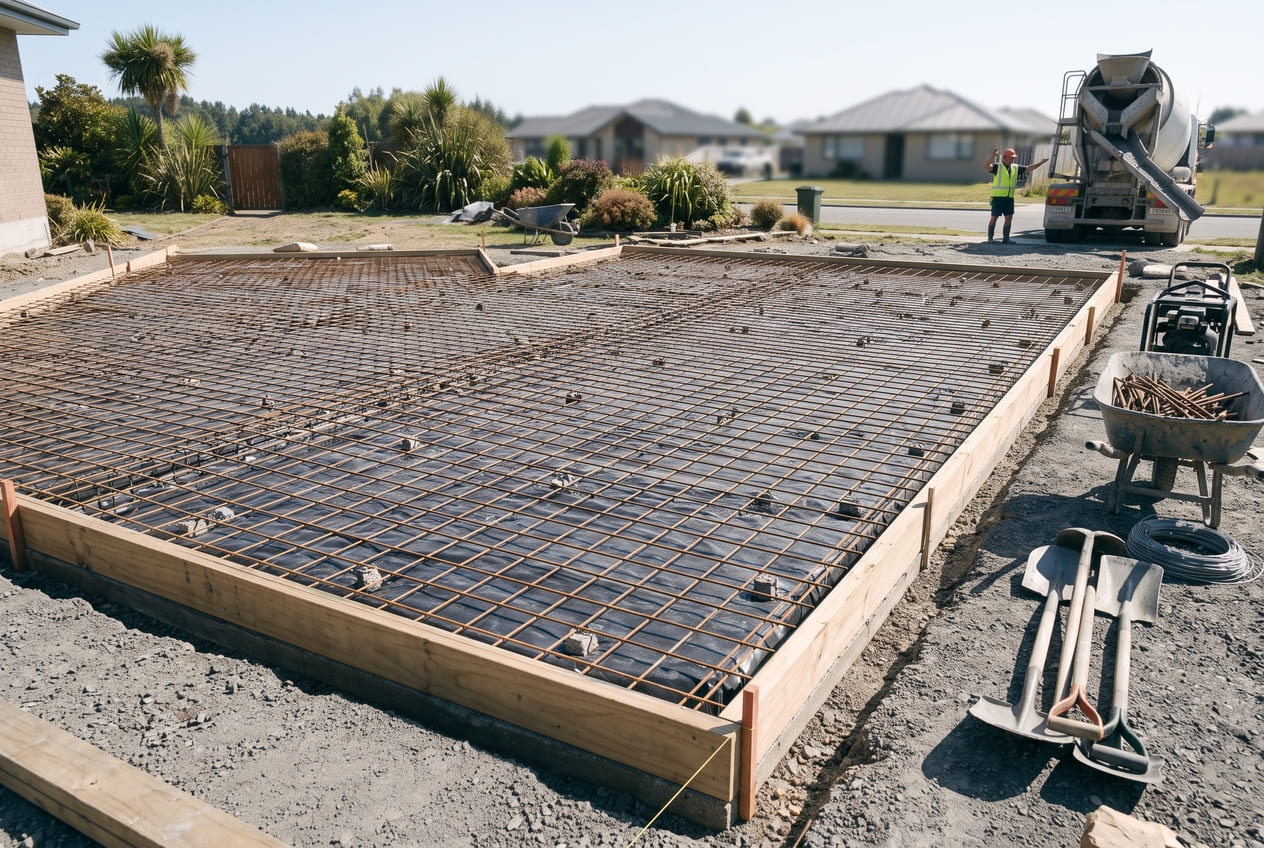
75mm to 100mm is standard for foot traffic only, thinner than a driveway since it never carries a vehicle. Light fibre reinforcing is usually enough rather than the steel mesh a driveway needs.
+Is there a minimum length worth doing?
Yes, there is a practical minimum since a crew and stamping equipment still need to come out regardless of length. We tell you that number up front rather than pricing a short entry path the same as a long garden walkway.
+How long does it take?
Most garden paths are poured and stamped within a day, with sealing following once cured. Longer or more complex curved paths may run to a second day.